
🚀 Mastering Computer Networking in DevOps : Introduction of Networking 🌐
"I'm a 3rd-year Computer Engineering student at Marwadi University with skills in C++, web development (MERN stack), and DevOps tools like Kubernetes. I contribute to open-source projects and share tech knowledge on GitHub and LinkedIn. I'm learning cloud technologies and app deployment. As an Internshala Student Partner, I help others find jobs and courses." now currently focusing on #90DaysOfDevops
What is Computer Network ?
A computer network is a group of devices connected together to share information and resources. These devices can include computers, servers, routers, and switches. The main goal of a computer network is to allow these devices to communicate and share things like files, applications, and internet access.
Here are some common types of computer networks:
Campus Area Network (CAN): This type of network covers a small area , like a campus of university
Local Area Network (LAN): This type of network covers a small area, like a home, office, or building.
Wide Area Network (WAN): This network covers a large area, often connecting multiple smaller networks, like the internet.
Metropolitan Area Network (MAN): This network covers a city or a large campus.
Personal Area Network (PAN): This network is for personal devices, usually within a few meters, like Bluetooth connections.
Networks can also be organized in different ways, called topologies, such as:
Star Topology: All devices are connected to a central device.
Ring Topology: Each device is connected to two other devices, forming a ring.
Bus Topology: All devices are connected to a single central cable.
Mesh Topology: Devices are interconnected, with multiple paths between them.
How the World is Connected via Submarine Optical Cables ?
Submarine optical cables are long cables laid on the ocean floor that connect different countries and continents. These cables are crucial for global communication and internet connectivity.
What Are Submarine Optical Cables?
- These are special cables that carry data using light signals. They are designed to be strong and durable to withstand the harsh conditions of the ocean.
Laying the Cables
- Ships specially designed for this purpose lay the cables on the seabed. The process involves careful planning to avoid underwater obstacles and ensure the cables are secure.
Connecting Continents
- These cables connect different parts of the world. For example, a cable might run from the United States to Europe, allowing data to travel between these continents.
How Data Travels
- Data, such as emails, videos, and web pages, is converted into light signals. These signals travel through the optical fibers in the cables at high speeds.
Landing Stations
- At each end of the cable, there are landing stations. These stations connect the submarine cables to the land-based internet infrastructure, allowing data to reach homes and businesses.
Maintenance and Repairs
- Sometimes, cables can get damaged by natural events or human activities. Special ships and underwater robots are used to find and repair these cables.
Importance of Submarine Cables
- These cables are the backbone of the global internet. They carry the majority of international data, making it possible for people around the world to communicate and access information quickly.
What is ISP?
An Internet Service Provider (ISP) is a company that provides individuals and organizations with access to the internet. ISPs offer various services, including internet connectivity, domain registration, web hosting, and email services. They connect customers to the internet through different technologies such as DSL, cable, fiber-optic, and wireless connections.
Examples of Indian ISPs include:
Bharti Airtel
Reliance Jio
Vodafone Idea
BSNL (Bharat Sanchar Nigam Limited)
ACT Fibernet
How Do the Different Tiers of Internet Service Providers (ISPs) Work?
The tiered model of Internet Service Providers (ISPs) helps to understand how different ISPs connect to the internet and serve their customers. Here’s a simple explanation with an example of an Indian company:
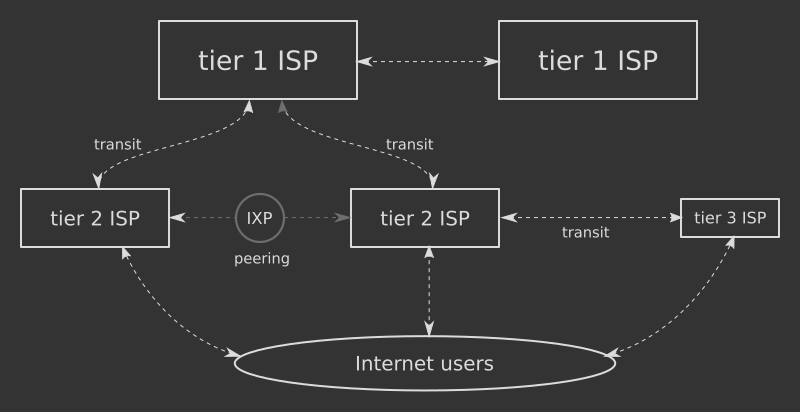
Tier-1 ISPs
What They Are: Tier-1 ISPs are the biggest and most powerful ISPs. They have networks that cover multiple countries and continents.
Key Points:
Global Reach: They can connect to any part of the internet without paying other ISPs.
Peering Agreements: They exchange internet traffic with other Tier-1 ISPs for free.
Infrastructure: They own major parts of the internet’s backbone, like undersea cables and large data centers.
Examples: Bharti , Tata , Reliance ,VSNL
Tier-2 ISPs
What They Are: Tier-2 ISPs are regional or national ISPs that connect to the internet through Tier-1 ISPs.
Key Points:
Regional Reach: They operate within specific regions or countries.
Peering and Transit: They have agreements to exchange traffic with other ISPs but also pay Tier-1 ISPs to reach parts of the internet they can’t access directly.
Customer Base: They serve many end-users, including businesses and homes.
Examples: Airtel,Reliance Jio,Vodafone Idea,BSNL
Tier-3 ISPs
What They Are: Tier-3 ISPs are local ISPs that provide internet access to individual customers and small businesses.
Key Points:
Local Reach: They operate in specific local areas.
Transit: They buy access from Tier-2 ISPs to connect to the wider internet.
Focus on End-Users: They mainly provide internet access to people and small businesses.
Examples: Local cable companies, small regional ISPs, ACT Fibernet (India).
In summary, the tiered model of ISPs shows how different types of ISPs connect to the internet and serve their customers, from global giants (Tier-1) to local providers (Tier-3).
Thank you for reading!
© 2024 Anand Raval. All rights reserved.


